
Best Video Cards by Price Hawkecentre.com Smart GPU Guide
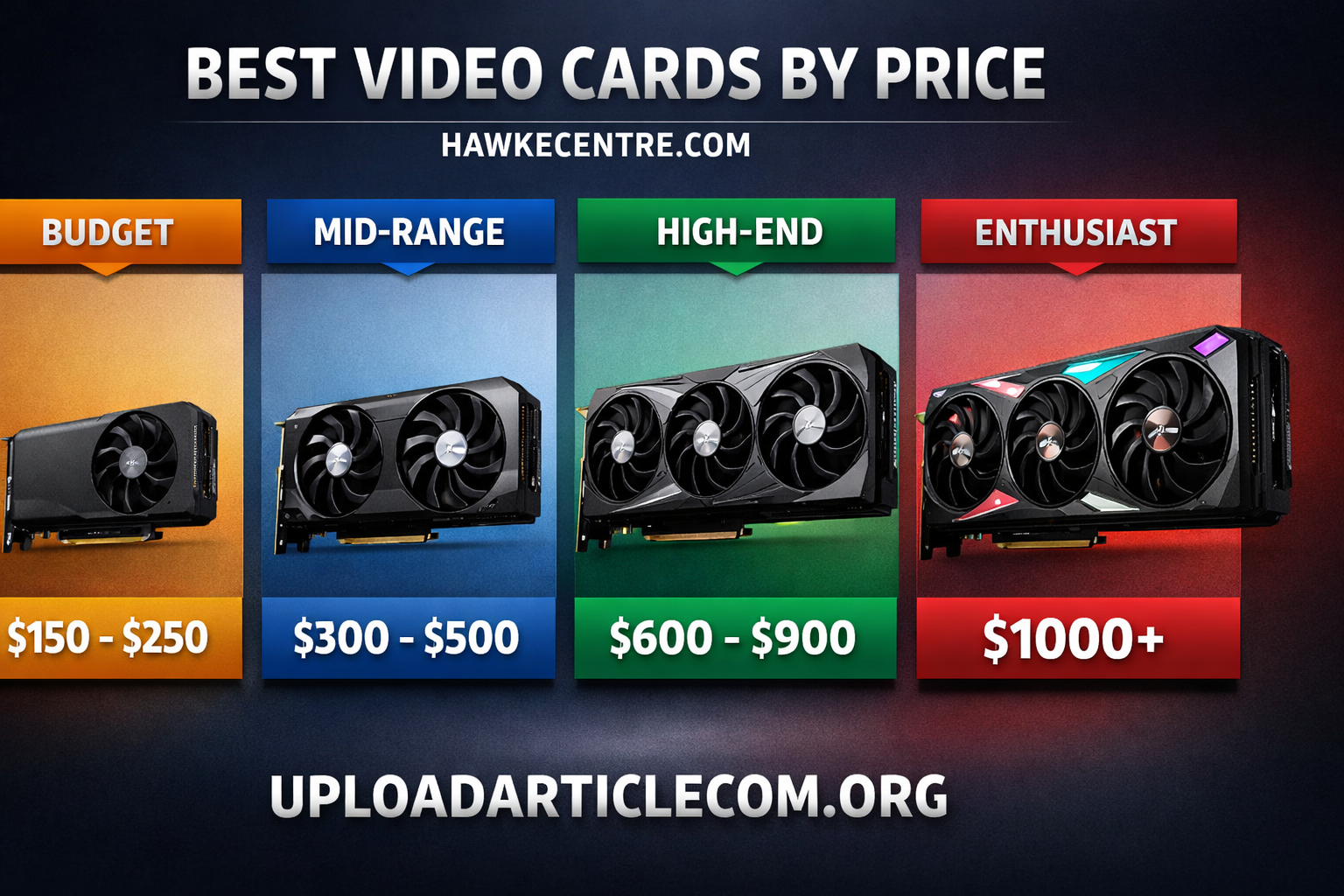
Best Video Cards by Price Guide – Hawkecentre.com Buyer Authority Hub
Choosing the right graphics card today is no longer about raw power alone—it’s about value intelligence. Gamers, creators, developers, and businesses are no longer asking “what’s the strongest GPU?” but rather “what delivers the best performance for my budget?” That’s where the concept of value-based GPU selection becomes essential.
The best video cards by price hawkecentre.com framework focuses on intelligent buying—matching real-world performance, longevity, efficiency, and reliability to actual cost tiers. Instead of chasing marketing hype, this approach builds a smarter path to performance, stability, and long-term satisfaction across every budget level.
Understanding Price-to-Performance in Modern GPUs
Price-to-performance is the core metric smart buyers use to avoid overpaying for marginal gains. It evaluates how much real-world performance you receive for every dollar spent, not just benchmark numbers or brand prestige.
In practical terms, this means comparing frame rates in real games, render speeds in creative workflows, AI processing capabilities, power efficiency, and driver stability rather than relying solely on synthetic performance scores.
Why Price-Based GPU Selection Matters More Than Ever
The GPU market has shifted dramatically due to supply chain volatility, AI computing demand, and mining cycles. Prices fluctuate faster than performance improvements, making smart value evaluation more important than raw specifications.
Choosing based on budget tiers allows buyers to secure consistent performance value, avoid inflated pricing traps, and build systems that remain relevant longer without unnecessary overspending.
Budget Tier GPUs: Maximum Value Under Entry-Level Pricing
Budget GPUs serve users who need reliable performance for esports, light creative work, education, and home systems. These cards prioritize efficiency, compatibility, and stable performance rather than extreme power.
They deliver excellent experiences for 1080p gaming, media creation, and productivity without high power consumption or expensive cooling requirements.
Mid-Range GPUs: The Market’s True Sweet Spot
Mid-range GPUs offer the best balance between performance and affordability. This tier is where modern gaming, streaming, and creative production converge efficiently.
These cards are powerful enough for high-refresh gaming, content creation, and multitasking while remaining accessible for most users building long-term systems.
High-End GPUs: Premium Performance, Strategic Investment
High-end graphics cards are designed for users who demand uncompromising performance in gaming, AI workloads, simulation, and professional rendering.
However, intelligent buyers evaluate not just power, but lifespan value, software ecosystem support, thermal design, and future compatibility before investing.
Performance Categories Explained for Smart Buyers
Different users need different GPU strengths. Gaming prioritizes frame consistency and latency. Creators focus on encoding, rendering, and memory bandwidth. Developers need compute acceleration and stability.
Understanding these categories prevents overbuying performance you will never use while ensuring you don’t underspec critical capabilities.
Energy Efficiency and Long-Term Cost Value
Power efficiency is a hidden cost factor. Efficient GPUs reduce electricity usage, heat output, and system cooling costs over time.
A slightly higher upfront GPU cost can deliver better long-term value through lower energy consumption and hardware stress.
Driver Support and Software Ecosystem Importance
Stable drivers and software optimization are essential for real-world performance. A GPU is only as good as its software support.
Long-term driver updates ensure compatibility with new games, tools, and operating systems, extending the usable lifespan of your investment.
Market Trends Shaping GPU Pricing
AI acceleration demand, cloud computing growth, and semiconductor shortages continue to reshape GPU pricing globally.
Smart buyers track these trends to avoid inflated pricing cycles and identify value windows for strategic purchasing.
Common Buyer Mistakes When Choosing by Price
Many buyers chase brand names, overpay for unnecessary performance, or ignore system compatibility.
Smart selection focuses on system balance, real-world needs, and long-term usability rather than hype-driven decisions.
Comparative Value Table: GPU Tiers by Price Strategy
| Price Tier | Primary Use Case | Performance Focus | Ideal User Type | Longevity Value |
| Entry-Level | Esports, education, office | Efficiency & stability | Students, home users | Medium |
| Mid-Range | Gaming, streaming, editing | Balanced performance | Gamers, creators | High |
| Upper-Mid | Advanced gaming, design | Power + efficiency | Enthusiasts | High |
| High-End | AI, simulation, 4K gaming | Maximum output | Professionals | Medium |
| Flagship | Enterprise workloads | Specialized performance | Studios, labs | Low |
Real-World Buyer Scenario
A content creator upgrading from a 5-year-old GPU may assume a flagship card is required. In reality, a mid-range modern GPU often delivers 3x performance improvement at half the cost with better efficiency and software support.
This is the core philosophy behind value-based GPU buying.
Expert Industry Insight
“Smart GPU buying isn’t about chasing the fastest card—it’s about finding the performance tier that delivers the highest real-world return for your money.”
— Independent hardware performance analyst
Hawkecentre.com Value Selection Framework
The best video cards by price hawkecentre.com strategy emphasizes structured decision-making, not impulsive upgrades. It aligns user needs, budget tiers, and performance demands into a practical buying system.
This framework avoids wasteful spending and ensures that every purchase delivers measurable value across performance, efficiency, and longevity.
Strategic Buying Windows and Market Timing
GPU pricing fluctuates based on release cycles, inventory refreshes, and demand shifts.
Smart buyers monitor these cycles to secure high-performance GPUs at reduced pricing during market corrections and stock refresh periods.
Performance Scalability and Future-Proofing
Future-proofing is not about buying the most powerful GPU—it’s about choosing a card that will remain compatible with future software demands.
Memory capacity, driver support, and architectural efficiency matter more than raw benchmark dominance.
Gaming Performance vs Productivity Performance
Some GPUs excel in gaming but underperform in creative workflows, while others are optimized for compute tasks.
Understanding this distinction prevents mismatched buying decisions and ensures performance aligns with actual use cases.
System Compatibility and Bottleneck Prevention
A powerful GPU paired with a weak CPU, insufficient RAM, or slow storage creates performance bottlenecks.
Balanced system design maximizes GPU value and prevents wasted investment.
Long-Term Reliability and Thermal Design
Thermal efficiency impacts lifespan. GPUs that run cooler last longer and maintain stable performance.
Build quality and cooling design are critical value factors often overlooked by budget-focused buyers.
Brand Value vs Real Performance Value
Brand reputation does not always equal better performance.
True value lies in real-world benchmarks, user experience consistency, and long-term reliability rather than logos.
Buyer Education as a Competitive Advantage
Informed buyers consistently secure better deals, better performance, and longer system lifespans.
Knowledge is the most powerful tool in GPU purchasing.
Conclusion
Choosing a graphics card is no longer about extremes—it’s about intelligence. The best video cards by price hawkecentre.com model represents a smarter way to invest in performance, aligning real-world needs with real-world value.
By focusing on price-to-performance, system balance, longevity, and efficiency, buyers gain more than just power—they gain stability, reliability, and long-term satisfaction. In a fast-changing GPU market, informed decisions are the true competitive advantage.
FAQ
What does best video cards by price hawkecentre.com mean?
It refers to selecting GPUs based on value efficiency, matching performance output to budget tiers for smarter long-term investment.
How often should GPUs be upgraded?
Most users benefit from upgrading every 3–5 years depending on workload growth and software demands.
Is mid-range better than high-end for most users?
Yes, mid-range GPUs often deliver the highest value-per-dollar for gaming and creative workflows.
Are expensive GPUs always better investments?
No, price does not guarantee value—real-world performance and longevity matter more.
How do I choose the right GPU tier?
Match your actual use case, system components, and budget to the appropriate performance tier.